Introduction
Centuries ago, people believed in their own superstitions about the inheritance of traits from one generation to another. However, no one knew what was responsible for this inheritance.
With the advancement of science, it became clear that there is a genetic material known as DNA (Deoxyribonucleic Acid) that is responsible for carrying genetic information from generation to generation, forming the basis of inheritance.
Now, we will discuss how and why DNA is the genetic material.
Properties of Genetic Material
The following conditions must be met for a structure to be considered genetic material:
- Be capable of forming its own replica (copy).
- Change due to mutation.
- Must be expressed in the form of Mendelian characters.
- Structurally and chemically stable.
Why is DNA the Genetic Material in Most Organisms?
DNA is the genetic material in most organisms. RNA can also act as genetic material, but it is less commonly used because RNA is more unstable and carries less genetic information.
Interestingly, DNA evolved from RNA through chemical modifications. DNA is more stable and can store larger amounts of genetic information.
Experiments Supporting DNA as the Genetic Material
The following three major experiments provided evidence that DNA is the genetic material:
- Griffith’s Transforming Principle (1929)
- Avery, MacLeod, and McCarty’s Experiment (1944)
- Hershey and Chase Experiment (1952)
Among these, the Hershey and Chase experiment became the most widely accepted evidence proving that DNA is the genetic material.
Griffith’s Experiment (1929)
This experiment was performed by Friedrich Griffith in 1929. It was the first attempt suggesting that bacteria are capable of transferring genetic information through a process known as transformation.
Griffith was studying the possibility of creating a vaccine for pneumonia using Streptococcus pneumoniae bacteria.
Types of Bacterial Strains
- S Strain = Smooth strain (virulent)
- R Strain = Rough strain (non-virulent)
Observations
- S strain → injected into mice → mice developed pneumonia and died.
- R strain → injected into mice → mice lived.
- Heat-killed S strain → injected into mice → mice lived.
- Heat-killed S strain + R strain → injected into mice → mice died.
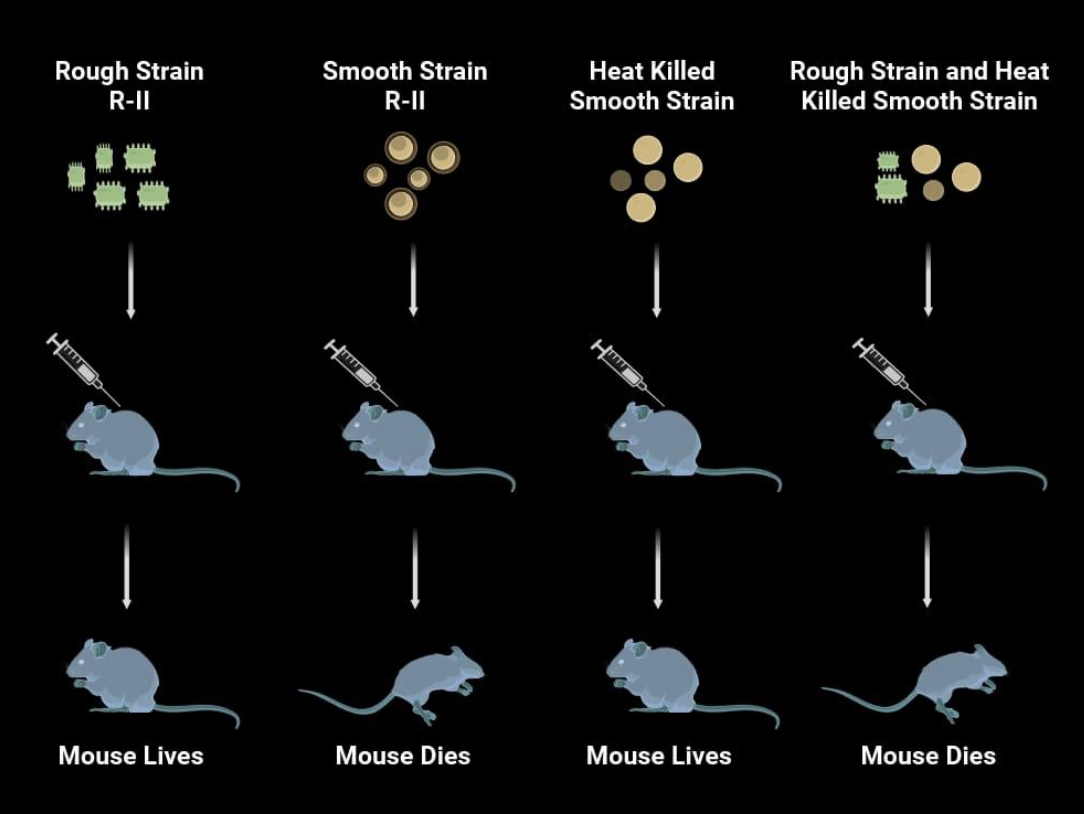
Figure (1): Griffith’s Experiment
Conclusion
Griffith concluded that the R strain had been transformed by the heat-killed S strain. This occurred due to the transfer of a “transforming principle” from the S strain to the R strain, making the R strain virulent.
Although important, Griffith’s experiment did not identify the biochemical nature of the transforming principle.
Avery, MacLeod, and McCarty’s Experiment (1944)
In 1944, Avery, MacLeod, and McCarty determined the biochemical nature of the transforming principle identified by Griffith.
Experiment
They treated heat-killed S strain bacteria with:
- Protease → breaks down proteins
- RNase → breaks down RNA
- DNase → breaks down DNA
They observed that transformation of the R strain was inhibited only when DNA was destroyed by DNase. Protease and RNase did not stop transformation.
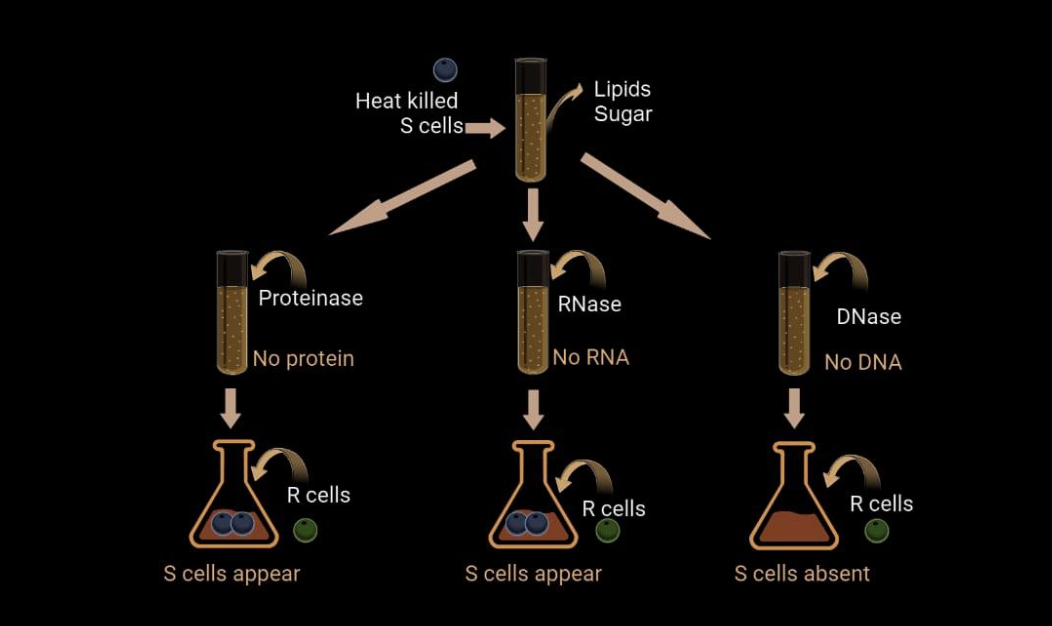
Figure (2): Avery, MacLeod, and McCarty’s Experiment (1944)
Conclusion
They concluded that DNA, and not protein or RNA, was the genetic material.
However, many biologists at the time were still not fully convinced.
Hershey and Chase Experiment (1952)
Further evidence that DNA is the genetic material came from experiments conducted by Hershey and Chase in 1952.
They studied the transmission of genetic information in the T2 bacteriophage, a virus that infects the bacterium Escherichia coli.
The T2 bacteriophage contains only DNA and protein, making it ideal for determining which molecule carried genetic information.
Experiment
Hershey and Chase grew viral cultures in the presence of radioactive isotopes:
- Phosphorus-32 (P-32) to label DNA
- Sulfur-35 (S-35) to label proteins
They then allowed the labeled viruses to infect E.coli bacteria.
After removing the viruses from the bacterial surfaces, they observed that bacteria infected with P-32 labeled viruses became radioactive, while bacteria infected with S-35 labeled viruses did not.
This demonstrated that DNA entered the bacterial cells and carried the genetic information.
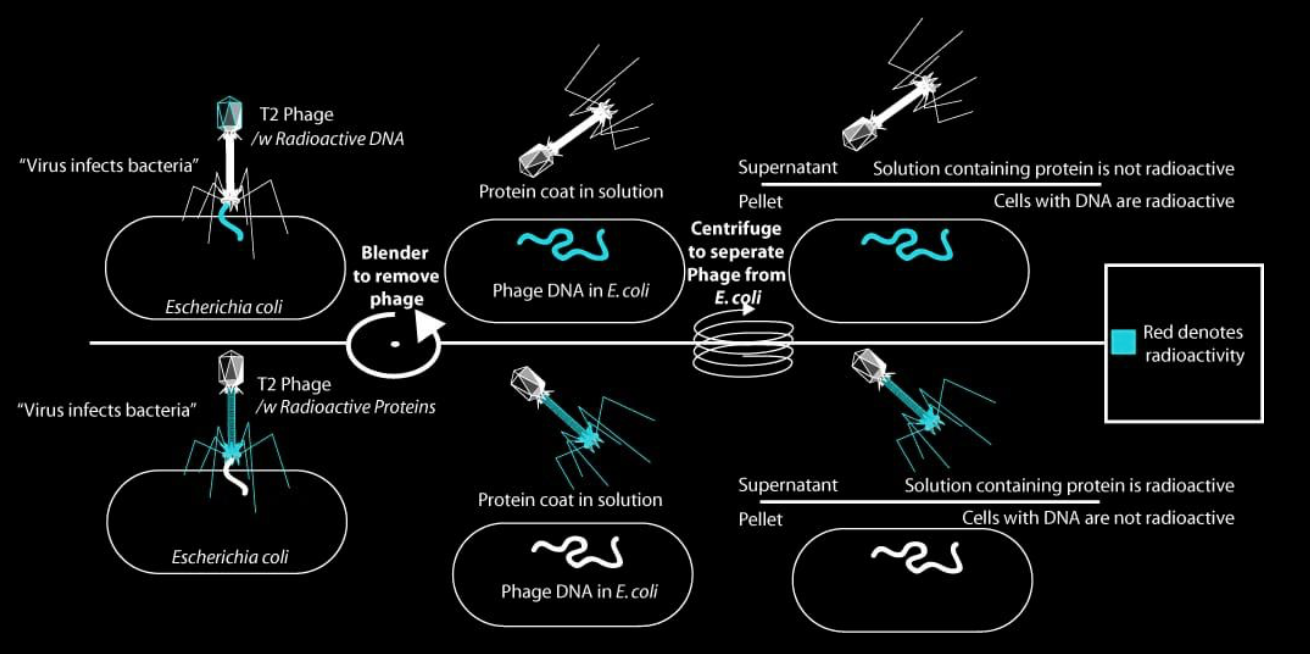
Figure (3): Hershey and Chase’s Experiment (1952)
Conclusion
Hershey and Chase concluded that DNA is the genetic material transferred from viruses to bacteria.
Written by Yasir Habib