Indicators are weak organic acids or weak organic bases with a specific chemical structure. The color of their molecules, i.e., the color of the indicator, differs from the color of their ions that result from their dissociation. The basic form of the indicator is responsible for this difference.
Let HΔ be an indicator that is a weak organic acid.
We write its dissociation reaction as:
\[\underset{\text{Colour A}}{Η \Delta} \; \rightleftharpoons \; \underset{\text{Colour B}}{H^+ + \Delta^-}\]
Colour of the indicator
- In an acidic solution
- In a basic solution:
In an acidic solution the \([H^+]\) is high so according to Le Chatelier principle the position of the chemical equilibrium shifts to the left and so the colour A predominates
In an acidic solution the \([OH^-]\) is high, which react with the \([H^+]\) reducing its concentration. So according to Le Chatelier principle the position of the chemical equilibrium shifts to the right and so the colour B predominates
Each indicator has:
- A pH range in which the color of the undissociated molecules predominates (color A)
- A pH range in which the color of the ions predominates (color B)
- An intermediate pH range where a mixture of the two colors appears (transition range)
So the colour of the indicator depends on the pH of the environment and the \(K_{\delta}\) of the indicator
Transition range
The transition range of an indicator can be calculated be the following formula:
\[pK_{\delta} \pm 1\]
If the transition range of an indicator matches the equivalence point of a titration, the indicator is suitable
Different types of indicators
| Name of Indicator | pKa | Range of pH | Color in acidic | Color in basic |
|---|---|---|---|---|
| Methyl Violet | 0.8 | 0.0 to 1.6 | Yellow | Blue |
| Thymol Blue | 1.6 | 1.2 to 2.8 | Red | Yellow |
| Methyl Yellow | 3.3 | 2.9 to 4.0 | Red | Yellow |
| Methyl Orange | 4.2 | 3.1 to 4.4 | Red | Yellow |
| Bromocresol Green | 4.7 | 3.8 to 5.4 | Yellow | Blue |
| Methyl Red | 5.0 | 4.2 to 6.2 | Red | Yellow |
| Chlorophenol Red | 6.0 | 4.8 to 6.4 | Yellow | Red |
| Bromothymol Blue | 7.1 | 6.0 to 7.6 | Yellow | Blue |
| Phenol Red | 7.4 | 6.4 to 8.0 | Yellow | Red |
| Cresol Purple | 8.3 | 7.4 to 9.0 | Yellow | Purple |
| Thymol Blue | 8.9 | 8.0 to 9.6 | Yellow | Blue |
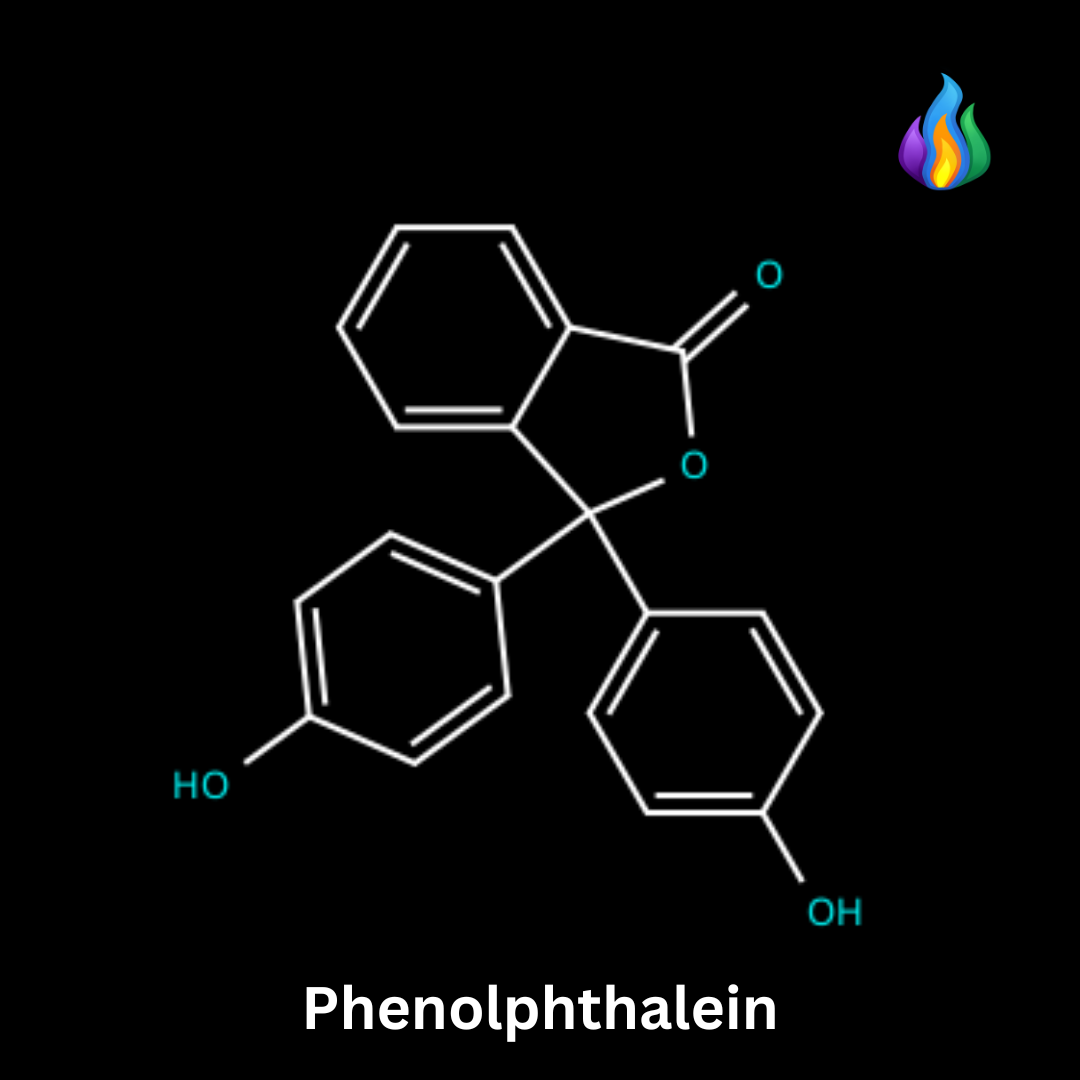
| Phenolpthalein | 9.7 | 8.0 to 9.8 | Colorless | Red |
| Thymolphthalein | 9.9 | 9.3 to 10.5 | Colorless | Blue |
| Alizarin Yellow | 11.0 | 10.1 to 12.0 | Yellow | Red |
| Indigo Carmine | 12.2 | 11.4 to 13.0 | Blue | Yellow |
Written by Fillios Memtsoudis