Phyllotaxy is the highly ordered arrangement of leaves on a plant stem. This arrangement is not random; it is an evolutionary adaptation designed to minimize self-shading. By optimizing the specific angle between successive leaves (the divergence angle), plants ensure that lower leaves still receive sufficient sunlight for photosynthesis and that the overall structure maximizes \(\ce{CO2}\) absorption
Introduction
Phyllotaxy is the highly ordered arrangement of leaves on a plant stem. This arrangement is not random; it is a biological adaptation that helps plants maximize sunlight exposure while minimizing self-shading.
By maintaining a specific divergence angle between successive leaves, plants ensure that lower leaves can still receive sufficient light for photosynthesis and gas exchange.
Main Idea: Plants arrange leaves using mathematical patterns to optimize survival.
Objectives
- Identify alternate, opposite, and whorled phyllotaxy.
- Determine the phyllotactic ratio.
- Calculate divergence angles.
- Understand the significance of the Golden Angle.
Skills Required
- Identifying Nodes: A node is the point where a leaf attaches to the stem. The region between two nodes is the internode.
- Numbering Leaves: Leaves must be labelled sequentially from older lower leaves to younger upper leaves.
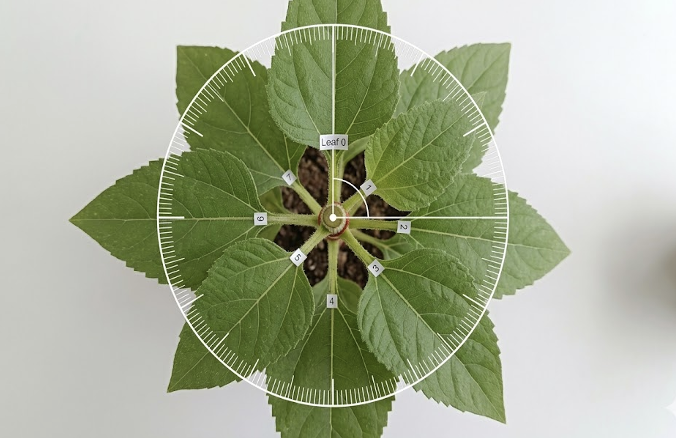
- Orthostichy: Observe the stem from the top to identify leaves aligned vertically.
Apparatus and Materials
- Fresh plant stems (Sunflower, Hibiscus, Mint, Oleander, etc.)
- Fine-tip permanent marker
- Non-stretchable thread or fine wire
- Clear protractor or goniometer
Experimental Procedure
This procedure is for the common Alternate (Spiral) phyllotaxy. It determines the Phyllotactic Ratio (m/n), where n is the number of leaves passed and m is the number of full turns completed before a leaf arrives directly above the starting point.
Steps
- Select a straight specimen: Choose a healthy, upright stem. A curved stem will introduce measurement errors.
- Define Leaf 0: Find a well-developed lower leaf and mark its node as "Leaf 0." (This leaf is not counted in the total n).
- Find the Vertical Match: Look directly down the axis of the stem from the top Locate the next leaf growing further up the stem that is perfectly aligned vertically with Leaf 0. Mark this leaf as "Leaf n."
- Count the Leaves (n): Start from the node above Leaf 0 (Leaf 1) and count every leaf base up to and including the node of Leaf n. This total is your value for n.
- Trace the Spiral Path and Count Turns (m): Take the thread/wire. Secure it at the node of Leaf 0. Wind the thread tightly around the stem, touching the base of every intermediate leaf (1, 2, 3...) in the shortest possible path, until you reach Leaf n. Count how many complete 360 revolutions the thread made around the stem. This integer is your value for m.
- Calculate the Divergence Angle: Divergence Angle = \(m \times \frac{360°}{n}\)
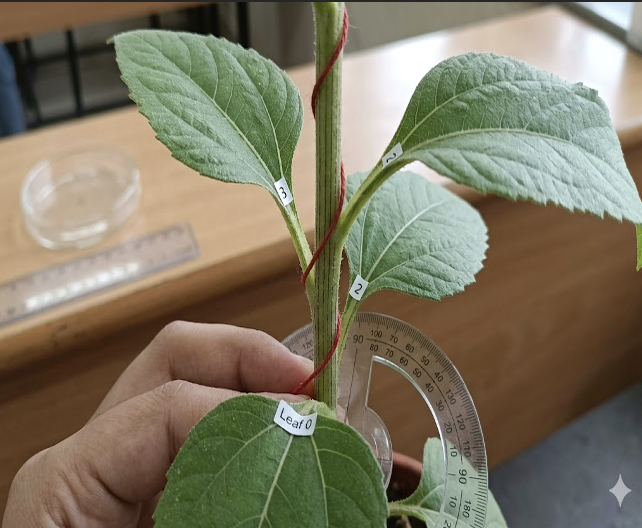
(Image: Demonstrating the technical skill of tracing a spiral with thread and marking leaves sequentially on a sunflower stem.)
Expected Results and Interpretation
The most significant finding in many spiral arrangements is the connection to the Fibonacci sequence (1, 1, 2, 3, 5, 8, 13...).
The Meaning of the Numbers
- In the \(\frac{2}{5}\) ratio (common in Hibiscus), the thread makes 2 full turns (m) and passes 5 leaves (n) before a leaf is vertically aligned. The angle is 144°.
- In the \(\frac{3}{8}\) ratio (common in Oaks), the thread makes 3 full turns and passes 8 leaves. The angle is 135°
- Observe that both m and n are usually Fibonacci numbers, with m being the first number added to make n.
The Rationale: The Golden Angle
Many plants exhibit a divergence angle very close to 137.5, known as the Golden Angle (derived from the Golden Ratio).
This specific angle (approx. 137.5°) is the most mathematically efficient way to pack leaves around a stem so that they never perfectly overlap, even after many rotations. This maximizes light exposure for every leaf on the plant and minimizes self-shading. If the angle were a simple fraction of 360° (like 90° or 120°), leaves would quickly align directly above one another.
Common Mistakes and Troubleshooting
- Miscounting the Start: This is the #1 mistake. Leaf 0 is the origin. Your leaf count (n) must start at the leaf above Leaf 0 (Leaf 1).
- False Vertical Alignment (Parallax Error): You must view the vertical alignment from a direct apical perspective (top-down), looking straight down the stem. Looking from the side will always give a false reading.
- Ignoring Stem Torsion: Some plants, like screw pines (Pandanus), have a twisted stem, which can twist the whole phyllotactic pattern. When tracing the thread, follow the actual nodes, not the perceived twist of the bark or stem surface.
- Assuming Pattern Consistency: A plant might show a 2/5 pattern on the main stem but a 3/8 pattern on side branches. Always measure the specific stem you are asked to analyze. Never memorize a ratio for a species; perform the measurement.